Despatch advice message (packing slip)
Version: Process description SALES005 v1.0
In the delivery process, the following general playing rules are of relevance:
- A shipment is a quantity of goods in one mode of transport, delivered at one particular moment at one particular delivery address through a means of transport;
- The parties in the messages are the same: the customer in the order message is the same customer in the despatch advice message;
- GTINs (trade items) mentioned in the packing slip shall be the same as those in the most recent order response;
- The unit of the trade item in the despatch advice message shall be the same as the unit that has been order or confirmed. E.g.: if boxes are ordered, the despatch advice message shall thus mention boxes (and no loose trade items);
- One despatch advice message is forwarded per shipment. An exception is the situation in which the shipment does not fit within one mode of transport. In this case, separate despatch advice messages shall be forwarded per mode of transport;
- Per shipment a despatch advice message is sent, even if multiple shipments are destined for the same destination;
- The despatch advice message is sent after the doors of the mode of transport are closed, to ensure that the data in the despatch advice message is the same as the goods that have been loaded into the mode of transport;
- If the shipment takes places as per an order, the order number shall be included in the despatch advice message;
- The customer and the supplier or sender and receiver are obliged to be filled out as a pair in the despatch advice message;
- The number found on the paper packing lsip and the despatch advice message number shall be identical;
- The delivery address is to be mentioned in the despatch advice message. Only in case of backhauling is this not of relevance (possibly, a pick-up address might have to be included);
- The primary and secondary load carriers are mentioned in the despatch advice message. If a deposit is places on the load carriers, these carriers shall be mentioned as trade item lines in the despatch advice message to enable the correct matching with the invoice.
Multiple orders in one shipment
It might occur that multiple orders for the same customer are delivered in the same shipment. In case, it is so that:
- For every order a despatch advice message shall be forwarded;
- If goods from several orders are placed on one load carrier, the above-mentioned rule is in place as well. The load carrier itself shall then be included in one of the despatch advice messages to prevent a double count.
Emergency procedure
The sender and receiver of the goods are expected to bilaterally agree on an emergency procedure in case the despatch advice message is not available (in time). If the despatch advice message is not available at the moment the goods are received, the receiving party shall have to register the number on the packing slip in his/her received-system to enable invoice-matching. In this manner, one is able to, at the very least, accept the shipment.
Playing rules for delivery date and time
- You are expected to indicate a delivery date/time at the delivery address if no set agreements have been made with your trading partners. A choice can be made for:
- Planned delivery date/time;
Earliest and latest delivery date/time (time block). With this combination, the delivery is indicated to arrive within a particular time frame.
Which structure do you prefer?
The despatch advice message allows detailed information regarding a shipment to be forwarded to the receiver of the shipment. This detailed information comprises:
- Information on the trade items to be delivered (and that have been ordered by the customer) and;
- Logistic information: on which load carrier the trade items are to be delivered.
There are two ways to incorporate this information in the despatch advice message. One can choose between the following possibilities:
- EANNL 1: only trade item information;
- EANNL 4: trade item and load carrier information specified to a particular SSCC per packing unit.
If you would like to optimally support the traceability and logistic processes, it is best to choose the option SSCC per packing unit.
In table 6, the two possibilities are illustrated through an example. In this example, it is presumed that a delivery of 48 trade items A and 20 trade item B arrive on two euro-pallets. On the first pallet are 34 trade items A, on the second pallet are 14 trade items A and 20 trade items B.
Table 1 - Example for different structure options
| Option | Tyoe | Explanation | Elaboration |
|---|---|---|---|
| EANNL 1 | Only trade item information | Trade item information provided in detail. No load carrier information is included. | Shipment: 48 pieces <GTIN-A>20 pieces <GTIN-B> |
| EANNL 4 | Trade item and load carrier information per SSCC | Trade item information and load carrier information per packing unit SSCC. | Shipment:<sscc1>- 1 europallet - 34 pieces <GTIN-A><sscc2>- 1 europallet - 14 pieces <GTIN-A>- 20 pieces <GTIN-B> |
How to handle various options?
Due to various possibilities, there is a risk of implementation differences occurring between supplier and customer. For example, when a customer has incorporated the option ‘Only trade item information’ and his supplier the option ‘Trade item and load carrier information per SSCC’. In this case, the following sector agreement should be adhered: which despatch advice structure (EANNL 1 and/or EANNL 4) is choses is a bilateral agreement between the supplier and customer.
Nesting
A special case is EANL 4: ‘trade item and load carrier information per SSCC’ which occurs with mixed wheelie. As such, several SSCCs occur per wheelie. An extra level is used to indicate which SSCCs are places together on one wheelie. This is called ‘nesting’.
1 Exchange despatch data
Shipment is meant to contain the processes in which the supplier and customer (usually in cooperation with the logistic service providers) control the delivery, reception and ownership conferral of goods and packaging (e.g. pallets, crates).
The construction and installation sector has distribution-centre deliveries (D.C. delivery), branche office delivery / direct shipment and crossdock-deliveries. Backhauling (pick-up order) might occur in all scenarios. The scenarios are shortly described below.
In all scenarios mentioned below, the despatch advice message can be used. The despatch advice message is used for the despatch advice of information regarding the delivered goods between the delivering and receiving party.
1.1 Types of deliveries
D.C. delivery
A D.C. delivery is a manner of distribution in which the orders are collected from the sending party collects the orders (e.g. with the manufacturer) and shipped to the distribution-centre of the receiving party (e.g. the D.C. of the wholesale business) to be placed in storage.
Direct delivery
A direct delivery is a manner of distribution in which the supplier delivers the goods directly to the shop of the customer; the goods are thus not collected first at the distribution-centre of the importer/wholesale business.
Crossdock-delivery
Crossdocking is a manner of distribution in which the goods are received in a crossdock (distribution) centre. These goods, however, are not taken into storage, but immediately prepared to be shipped further. Crossdock-deliveries are also called transit-deliveries. With crossdocking, the orders for the stores are, for example, collected first at the delivering party (e.g. manufacturer, logistic service provider) and grouped per final destination. These are then driven to the crossdock-centre, to be placed with the shipment/cargo heading towards the final destination.
Backhauling/pick-up order
A backhaul delivery is a manner of distribution in which the orders are collected with the delivering party, and where the receiving party handles the transport. After the collection of the goods, one proceeds with branche office delivery, DC-delivery or crossdock-delivery. Backhauling is recognised in a message through the indication ‘backhauling’. This indication indicates furthermore that a shipment should be processed financially as ‘ex works/from factory’.
2 Playing rules with backhauling
- In case of backhauling, the indication ‘backhauling’ is included in the despatch advice message. As such, the receiving party knows that he/she should take care of the transport of the goods;
- With backhauling, the pick-up address should be included in the despatch advice message;
- With backhauling, the deliver date/time should be interpreted to be the date/time at which the receiving party picks up the goods at the pick-up address.
3 Playing rules for crossdocking
In case of crossdocking three despatch advices are send:
- The supplier sends a despatch advice to the final destination;
- The supplier sends a despatch advice to the crossdock-location;
- The crossdock stations sends a despatch advice the final destination.
A. Supplier to final destination
- You indicate the delivered trade items and secondary load carriers. Possibly, additional trade item data can be mentioned next to the GTIN, such as: best-before date, batch number;
- You do not indicate the primary load carriers. Beforehand, it is not known at which final destination the primary load carriers shall be delivered;
- You incorporate the GLN of the final destination in the despatch advice message;
- You indicate the delivery date/time ‘final destination’, the delivery date/time;
- ‘delivery address’ is optional.
B. Supplier to crossdock-centre
- You forward the despatch advice message for the crossdock-centre for one total shipment;
- The shipment is to be delivered in one truck from one location to one crossdock-centre; n this case, the GLN of the delivery address is the same as the crossdock-centre;
- You include the GLN of the final destination in the despatch advice message;
- The shipment can contain multiple packing units meant for various final destinations. The address codes of the final destination is, in this case, indicated at the level of the packing unit;
- You indicate the delivered trade items and the secondary load carriers with indication;
- ‘delivery without conferral of ownership’. The goods and secondary load carriers are not included in the invoice to the crossdock-centre;
- You indicate the primary load carriers. The primary load carries are included in the invoice to the crossdock-centre;
- You indicate the delivery date/time ‘final destination’. If there are several final destinations, these are indicated per shipping unit. The delivery date/time ‘delivery address’ is optional.
C Crossdock-centre to final destination
- You indicate the delivered trade items and secondary load carriers with indication;
- ‘delivery without conferral of ownership’. The goods and secondary load carriers are not included in the invoice to the crossdock-centre;
- You indicate the primary load carriers. The primary load carriers are included in the invoice to the crossdock-centre;
- The crossdock-centre may combine in one shipment various deliveries for the same final destination. For example, goods from a crossdock-delivery with goods from a DC-delivery. In the despatch advice message, the delivered trade items and secondary load carriers are thus indicated only for the crossdock-part as ‘delivery without conferral of ownership’.
Homogenous/heterogenous load carriers
- If the complete load carrier is destined for the same final destination, it is assigned one SSCC, no matter whether it is a homogeneous or heterogenous load carrier. The SSCC is, as such, assigned final destinations at level with crossdock-deliveries.
- The GLN of the final destination should be placed on the GS1 label;
- In this manner, it is possible for the receiving party to conclude the crossdock-process through scanning.
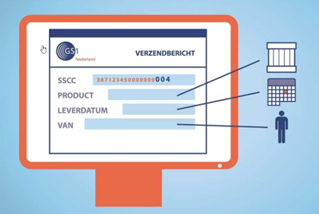
Figure 1 - Use of SSCC in teh Despatch Advice (source: www.gs1.nl)
Sandwich pallets
With crossdocking, sandwich pallets are often used to group the goods per final destination. These are from then on treated as loose homogenous or heterogenous load carries, with a SSCC per layer instead of the complete pallet. It is not possible to derive from a despatch advice message that these layers are stacked within one sandwich pallet. Sandwich pallets are treated as loose homogenous or heterogenous load carriers. It is therefore not possible to derive from the despatch advice message that these pallets are stacked.
4 Playing rules with DC-delivery
Homogenous load carriers
- At the very least, a GTIN of the trading unit, the quantity and a SSCC should be assigned to the label of a homogenous load carrier;
- If no despatch advice message is sent to the customer beforehand, the labels placed on the load carrier should, at the very least, contain the quantity, the due date or best-before date and the batch/lot number;
- The label of a homogenous load carrier which is part of a sandwich pallet should contain, per layer, at the very least a GTIN of the trading unit, quantity and the SSCC. Heterogenous load carriers
- The label of a heterogenous load carrier should only contain a SSCC. Due to the great variety in trade items, it is not possible to provide additional product information.
5 Playing rules with branche office and direct shipment
Homogenous/heterogenous load carriers
- With branche office-delivery, heterogenous pallets or trolleys are commonly used. One SSCC for the entire load carrier is sufficiënt;
- The label of the load carrier should, at the very least, contain a SSCC.
Playing rules GS1-laber and despatch advice message
The ultimate goal of the GS1 label is to provide clear and precise information regarding the packing unit (load carrier, cask) on which the label is placed, and the trade items within this packing unit. The GS1 label contains, among others, the SSCC, which is also incorporated in the despatch advice message.
Through scanning a (pallet) label (SSCC), combined with the despatch advice, the unloading of trucks takes up much less time, and is it immediately known what has been delivered. The process concerning the receipt of goods is, as such, much faster and more reliable.
More information regarding the use of the pallet label in combination with the GS1 label can be found via the Dutch GS1 Nederland.