Terms Message
Version: Proces specification SALES005 v1.0.1
With the terms message, supplier-/ or customer-specific agreements can be communicated. Discounts or surcharges that have together been agreed upon can be forwarded via this message, so that the price catalogue message shall remain mostly of a general nature. The Terms message does not concern itself with trade item specific information, but merely focuses upon price information. The price determination as determined with the terms message knows several overlaps and similarities with the application of discounts as described in paragraph 6.1.
1 General playing rules for the Terms message
In the process of data messages, the following general playing rules are applicable:
- Before the terms are exchanged, relevant business- and trade item information should be exchanged;
- The trade item information and the terms-information are to be exchanged independently (in time) from one another. The order in which the information is send is not relevant, but the information can only be regarded as effective if it is present in both information systems;
- With a modification in the terms, not just the modified data is to be send, but also the unmodified terms. A complete set of terms is exchanged as the product range usually contains large amounts of trade items and the checking of all of them would take too much time. The complete set of terms thus replaces the earlier-sent set of terms;
- In the absence of a GTIN, it is obligatory to mention the trade item code of the supplier;
- To indicate the type of terms within the terms message, it is not allowed to use other codes other than those provided: BC (basic terms), AC (action terms), and PC (project terms).
- An trade item or discount group might have several terms. It is therefore of importance to display all terms within the message.
2 Terms
The exchange of terms or customer-specific agreements with trading partners can be done on the basis of three terms types:
- Basic terms: basic agreements concerning (nett) prices, and discounts regarding the product range. These terms contain at the very least a starting date;
- Action terms: agreements concerning (nett) prices and discounts regarding the product range particular to an action. The action terms concern a specific period, with both a starting and end date;
- Project terms: agreements concerning (nett) prices and discounts regarding the product range particular to a specific project.
These basic, action, and project terms concern both individual trade items and discount groups.
2.1 Exchange of terms
In this case the terms are exchanged between the supplier and the customer. The process through which terms data is exchanges starts as soon as a first relation is created between the supplier and the customer, or when a modification occurs in existing terms.
2.2 Plan of attack
Below you will find the various steps to be completed within this particular case:
- The supplier draws up a message with the terms under which he is willing to deliver the products to a specific customer. This can be basic, action and project terms;
- The supplier sends the different terms in a terms message via the transaction protocol employed by both parties to the particular customer;
- The customer receives this terms message and processes the terms. The import enables the terms to be automatically processed within the system;
- The customer is now aware of the latest discounts and prices.
After this, the customer can place his/her order(s) with the supplier. Based upon the terms and the placed order, the customer is better enabled to draw up the invoice.
The process outline for the using of the order is laid down in the process document related to transaction messages.
3 Processing triangle
In the sections above it has been mentioned how the customer shall receive the terms message and how the terms are automatically processed in the administration. In this section it shall be explained how this processing is to be executed.
To arrive at the correct price determination, the terms message should contain all relevant terms per trade item, trade item group and/or customer. The processing methodology ensures that, with the price determination via the terms message, no terms from the price catalogue message are taken into the price determination. Surcharges cannot be included within the terms message, but are determined through the price catalogue message, and remain thus valid when using the terms message.
There are two processing methodologies:
- A ‘batch-like’ method, where the correct pricing in the trade item data are processed integrally;
- A ‘real-time’ approach, where the actual price for an trade item is always directly calculated when requested.
3.1 Determining the data to be processed
The processing has as its ultimate goal to determine beforehand that only the data derived from both the trade item data and the terms that is relevant at that point in time is to be sued for determining the price.
This means that trade item data shall be processed that (if applicable):
- Has an actual starting date catalogue;
- Has an actual starting date contract;
- Has an actual date that is valid;
- Has an actual starting date price information;
- Has an actual starting date discount;
- Has a status code that is not equivalent to ‘discontinued’;
- Has no negative nett price or gross margin.
The same can be said to apply to the to-be-received terms. Similarly, for those only those terms shall be processed for which (if applicable):
- The processing date lies between either the to-be-received date at which validity starts, or the date at which validity ends;
- The value of the terms discount is not negative or more than 100.
3.2 Usage of the data
- Every term – no matter what type – has a starting date. If there is an end date for a particular terms type, it is obligatory to mention this. If no end date is known, than this does not have to be mentioned.
- An overlap in date with various terms is allowed; a basic terms and an action terms may have an overlap in time.
3.3 Usage of prices and discounts
- If no usage is made of the given percentage discount, one is obliged to make known the price value;
- If the nett price is not mentioned, one is obliged to mention any percentage-based discounts;
- If within one terms both the nett price and the percentage are filled out, the percentage is merely there for extra information;
- A percentage increase can occur maximum three times per terms type;
- The mentioning of a reduction-serial number is obligatory if several discount percentages are indicated.
3.4 Processing methodology price determination
With the remaining trade item data and terms it is possible to determine per trade item the nett price. This happens with a priority. The price is determined in accordance with the below-found priority scale. If the nett price for a terms line has been calculated, it shall no longer be attempted to determine a price for this terms line based upon a lower priority. Do mind: surcharges are to be charged separately.
Table 1 - Price priority
| Priority | Net price: |
|---|---|
| 1 | Nett price trade item from the terms message The nett price from the terms, if a specific trade item with the trade item identification can be determined. |
| 2 | Discount percentage trade item from the terms message Calculated based upon the discount from the terms and the gross margin, if a specific trade item with trade item identification can be determined. If the gross margin from the trade item data is not filled out, the trade item should not be processed. The source of the trade item data shall then be requested to provide the correct data. |
| 3 | Discount group from the terms message Calculated with the discount from the terms and the gross margin from the trade item data, if a specific trade item, or a group of trade items, with the trade item grouping can be determined. . If the gross margin from the trade item data is not filled out, the trade item should not be processed. The source of the trade item data shall then be requested to provide the correct data. |
| 4 | Nett price trade item from trade item data The nett price from the trade item data, if this has a value surpassing or equal to 0. |
| 5 | Gross margin trade item from trade item data The gross margin from the trade item data, if this has a value surpassing or equal to 0. This shall be calculated based upon the relevant discounts/surcharges solely found in the price catalogue message. |
| 6 | Price at request For any remaining trade items it is assumed that the price is only made known upon request. |
Signalling of unwanted price determinations After the determination of the nett price, it is recommended to perform several checks on results that might be unwanted:
Missing discount groups
It might occur that discount groups are found within the trade item data, but not in the terms. In order to enable the processing methodology, it is preferred to request a complete terms message from the supplier of both the trade item data and the terms message.
- Nett price is higher compared to the gross margin
It might occur that in the results of determining the nett price, this is higher as compared to the gross margin found in the trade item data. The source of the trade item data shall then be requested to provide the correct data. - Nett price terms message is higher compared to the nett price price catalogue message
The lowest nett price is always leading.
3.5 Operation wildcard coding discount group
A wildcard may be incorporated within the coding of the discount group. When determining the nett price, it is important to handle this appropriately. It should be kept in mind that:
- First calculations are made with the discount for the entire discount group of a particular trade item;
- The discount for the higher-situated discount group with a wildcard will be calculated next. The discount group with the trade item data is entered repeatedly with one character from the right and complemented with a wildcard.
This principle is shown in the example found below:
Table 2 - Coding of a Allowance group
| Terms data | |||
|---|---|---|---|
| Coding allowance group | 2001 | 200* | 20* |
| Allowance | 50% | 30% | 20% |
Table 3 - Coding of a Allowance group
| Trade item data | |||||||
|---|---|---|---|---|---|---|---|
| Coding allowance groupp | 2001 | 2002 | 20012345 | 200 | 201 | 2012345 | 20 |
| Allowance | 50% | 30% | 30% | 30% | 20% | 20% | 20% |
Individual trade items and discount groups
- The terms concern individual trade items and discount groups;
- If an trade item belongs to a discount group, one is obliged to mention the discount group;
- An trade item or discount group may fall within various types of terms (e.g. in both a basic terms and an action terms).
4 Playing rules for basic terms
Playing rules for basic terms:
- A scale is only used at trade item’s level; it applies to one specific trade item and not at group discount level;
- An overlap in data within a basic terms is allowed, so long as another lower limit scale is applicable;
- It is recommended to indicate, if known, an end date with a basic terms;
- It is not allowed to mention for the same period (period starting date – period end date) two different prices with the same lower limit scale. An trade item cannot have two different prices in combination with the same lower limit scale. As such, it will be unclear for the customer which price is the correct one.
Example: Base terms
The supplier has laid down the following base terms for trade item A:
Table 4 - Base terms I
| Terms base I - Trade item A | |
|---|---|
| Time window: | 1-1-2018 untill 31-12-2018 |
| Price: | 80 euro |
Table 5 - Base terms II
| Terms base II - Trade item A | |
|---|---|
| Time window: | 1-1-2018 untill 31-12-2018 |
| Price: | 78 euro; with lower limit 500 |
Table 6 - Base terms III
| Terms base III – Trade item A | |
|---|---|
| Time window: | 1-1-2018 untill 31-12-2018 |
| Price: | 75 euro; bulk discount with lower limit 1500 |

Figure 1 - Time window
It is, however, no allowed to mention two different prices with the same lower limit scale:

Figure 2 - Time window with two different prices with the same bulk-lower limit (red isn’t allowed)
5 Playing rules for action terms
Playing rules for action terms:
- If an action discount for a particular trade item is present, while there is simultaneously an action for a discount group to which the trade item belongs, the terms that amounts to the lowest price is leading;
- It is obligatory for an action terms to mention the end date;
- An overlap in date in the action terms is not allowed. Two action terms for one trade item cannot be found within the same period.
- No two different prices as action terms are to be allowed within the same period (period starting date-end date). Neither is the combination of price + discount percentage and discount percentage + discount percentage allowed within the same period.
Example: Action terms
The supplier has laid down the following basic and action terms for Trade item A. Two different terms can be found within the same period; an overlap in data belonging to different terms is allowed.
Table 7 - Action terms I
| Basic term I - Trade item A | |
|---|---|
| Time window: | 1-1-2018 t/m 31-12-2018 |
| Price: | 80 euro |
Table 8 - Action terms II
| Action terms I - Trade item A | |
|---|---|
| Time window: | 1-4-2018 t/m 31-5-2018 |
| Price: | 75 euro |
Table 9 - Action terms III
| Action terms II - Trade item A | |
|---|---|
| Time window: | 1-8-2018 t/m 30-9-2018 |
| Price: | 77 euro |

Figure 3 - Date in action terms
An overlap in data in the action terms is, however, not allowed:

Figure 4 - Overlapping dates in action terms is not allowed (red isn’t allowed)
6 Playing rules for project terms
Playing rules for project terms:
- If a term concerns a project term (PC), one is obliged to mention the project number;
- Within one project, it is not allowed to place several terms within one period;
- An trade item might be found within several projects with different pricing or discount within the same period;
- An overlap in data within one project number is not allowed. Within a project number it is not allowed to have a different terms within the same period.
Example: Project terms
The supplier has laid down a basic terms for trade item A for a particular period. At the same time, a project terms for the same trade item A is determined for project 25C.
Table 10 - : Base terms I
| Base terms I - Trade item A | |
|---|---|
| Time window: | 1-1-2018 t/m 31-12-2018 |
| Price: | 80 euro |
Table 11 - Base terms I – Project 25C
| Project terms I - Trade item A Project 25C | |
|---|---|
| Time window: | 1-2-2018 t/m 30-4-2018 |
| Allowance: | 10% |
Table 12 - Base terms II – Project 25C
| Project terms II - Trade item A Project 25C | |
|---|---|
| Time window: | 1-10-2018 t/m 31-12-2018 |
| Price: | 77 euro |
The supplier has laid down the following basic and project terms for trade item A with project DH9:
Table 13 - Base terms I
| Base terms I - Trade item A | |
|---|---|
| Time window: | 1-1-2018 t/m 31-12-2018 |
| Price: | 80 euro |
Table 14 - Project terms – Project HD9
| Project terms I - Trade item A Project HD9 | |
|---|---|
| Time window: | 1-2-2018 t/m 30-4-2018 |
| Allowance: | 10% |
Project terms are agreements for specific projects; it might occur that trade item A has a allowance of 10% for project 25C from 1-2-2018 until 30-4-2018, while in the same period trade item A is priced at €75 for project HD9.
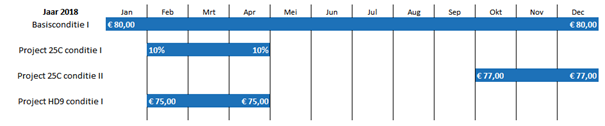
Figure 5 - Project terms are price agreements for specific projects
An overlap in data within one project number is not allowed:
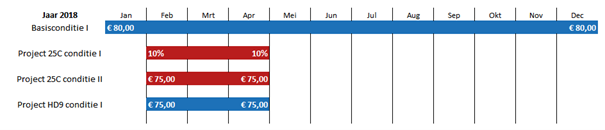
Figure 6 - An overlap in the period within the same project number is not allowed (red isn’t allowed)