Price catalogue message
Version: Process description SALES005 v1.0.1
With the price catalogue message, the supplier can indicate, among others, which trade items are in his/her catalogue, how they are packaged, with which GTIN (GS1 trade item code), for which price, and allows for the accompaniment of any relevant variables and/or modifications in the message. The price catalogue message contains furthermore information regarding the order unit, price unit and the user’s unit. Technical characteristics shall be communicated via the product message.
1 General playing rules for the price catalogue message
- The supplier is the source of the trading information. The exchange of trade item data might occur in two ways:
- The customer indicates which data he/she would like to receive from the supplier and thus files a request with the supplier;
- The supplier confirms the accorded agreements by forwarding the price catalogue message to the customer.
- The price catalogue message is not just used to make price mutations known, but also to confirm whether a particular trade item is or is not (no longer) available for delivery. Next to that, changes can be found in the logistic characteristics.
- Mutations are accompanied by a starting date. To ensure the correct processing of the data it is of importance that the data is exchanged between the supplier and the customer in time.
- Payment agreement and most of the supplying terms are not recorded within the price catalogue message. There are expected to have been agreed upon between the supplier and the customer;
- The supplier shall not forward an trade item mutation in case of a complete change in the VAT rates (e.g. an increase from 19% to 21%). The customer is expected to change such mutations on his own initiative. The supplier shall forward trade item mutations if there is a limited change in the VAT rate (e.g. a change in trade items with a low VAT rate to a high VAT rate);
- Reductions are always relevant for the gross margin, not the net price;
- If the gross margin is the price made known, the receiver should be able to calculate the nett price based upon the gross margin and the reductions and surcharges;
- If a price indication is included, this only serves an informative goal;
- If there is a bilateral exchange, the nett price can be included;
- The published delivery times are informative and no rights can be derived from this.
2 General price catalogue message
The general trade item data concerns trading information regarding the trade items found in the supplier’s catalogue. This includes technical terms and information such as the GTIN, the trade item code, the manner of packaging, the trade item description, the minimum amount to be bought and general information on pricing and any changes made (changes in pricing, reductions and surcharges on existing products), etc. The general trade item data concerns information on the catalogue that is identical for all interest customers.
2.1 Playing rules in case of ‘general trade item data’
This section describes the playing rules that are applicable in cases of general trade item data exchange. The following rule is applicable in the exchange of general trade item data:
The supplier might make it known at any point in time, subject to certain terms, that general trading data is no longer valid (mutation code).
2.2 Plan of attack
Below you will find the various steps to be completed within this particular case:
- The supplier uses the mutation code ‘modification’ or ‘original’ to indicate whether the document only exchanges modifications, or whether it is the updated file that is being exchanged (possibly discontinued products are not recorded in the document);
- When exchanging changes, the supplier can then indicate whether the item is incoming, new/available (current), expired or expired;
- The customer shall update his file with the muted product data.
It is possible to exchange general trade item data via a data pool. The supplier enters his trade item data once into a data pool and makes this known among the customers. Mutations are to be delivered by the supplier him/herself to the data pool, and the customer can ensure him/herself that his/her trade items are up-to-date via a data pool.
3 Customer-specific price catalogue message
With a customer-specific article message the price catalogue message is exchanged bilaterally between the supplier and the customer. The terms are laid down in a contract between the supplier and the customer. This price catalogue message is specific per customer. Furthermore, technical terms and information such as the GTIN, the trade item code, the manner of packaging, the minimum amount to be bought and any relevant price information/changes (changes in pricing, reductions and surcharges on existing trade items) can be exchanged, though this information is particular for every individual customer
3.1 Playing rules in case of ‘customer-specific trade item data’
This section describes the playing rules that are applicable when customer-specific trade item data is being exchanged. Below one can find the playing rules for the exchange of customer-specific trade item data:
- A contract between the supplier and the customer is always the basis for customer-specific trade item data;
- Agreed-upon pricing data shall be provided including the trade item data;
- Trade items can be added, modified or discontinued under the accorded agreements;
- If there is a change in supplying terms (GTIN and/or trade item’s code supplier remains the same), all data for a particular trade item shall be forwarded, and thus not only the modified data.
3.2 Plan of attack
Below you will find the various steps to be completed within this particular case:
- The supplier and the customer have enacted a contract that contains the pricing and terms regarding the trade items offered by the supplier to this specific customer;
- The supplier uses the mutation code ‘modification’ or ‘original’ to indicate whether the document only exchanges modifications (after these have contractually been agreed upon), or whether it is the updated file that is being exchanged (possibly discontinued products are not recorded in the document); *In case there is an exchange of modifications, the supplier can accordingly indicate whether the product is new item not available yet, new/available (up-to-date), discontinued, suspended, or deletion announcement only. Classifying something as ‘destroy publication’ indicates that wrong data can be deleted.
- The customer shall update his file with the muted product data.
This data may deviate from general trade item data provided for by the supplier (differing reductions, surcharges, packaging, supply terms).
3.3 Status and mutation code
To ensure synchronisation between the product records of both supplier and customer, it should be clear for the receiver how to process the supplied information. The mutation code can be made known at message level; the mutation shall apply to all products or trade items within that particular message. The status code is applied to indicate wat happens in the transition phase if the product data is modified..
The mutation code can indicate the nature of the modification of the stock at message level within the product message:
Table 1 - Mutation at the header
| Mutationcode | Meaning |
|---|---|
| 4 | Modification (only the mutations are being exchanged) |
| 9 | Original (the complete and updated file is being exchanged) |
The status code is used to provide information about the mutation at line level:
Table 2 - Statuscode at line level
| Status code | Meaning |
|---|---|
| 125 | Trade item is new item not available yet: the trade item shall in the near future be incorporated within the catalogue |
| 126 | New/available |
| 94E | The trade item is deletion announcement only: the trade item shall in the near future no longer be available for delivery. If this is the case, it is possible to add a ‘follow-up’.. |
| 130 | Discontinued |
| 155 | Destroy publication |
| 175 | Suspended (e.g. seasonal items) |
4 Using a Unit Triangle
When exchanging item data, we include how to order the item (minimum order, step size and Unit quantity), what the price of the item is (price and/or conversion price) and what one receives (the number of use units).
The avoid any miscommunication, the following definitions are used within the SALES Standard:
- Ordering unit: the ordering unit and the unit of the minimum order are equal. The ordering unit might be, for example, ‘box’, and the unit for minimum order shall thus accordingly be ‘box’ as well and not ‘x’ times the contents of that box. The minimum order is the amount of ordering units of a particular trade item that is to be taken at the minimum when placing an order for that trade item. The ordering unit is linked to the GTIN and the scaling. The ordering unit is thus related to the trade item data, and not the product data; Example: GTIN = box with 12 bulbs. The ordering unit is ‘box’, and the minimum order is thus a number that indicates x times the ‘box’. With a minimum order of 1, one shall thus receive 12 bulbs, with 2 this shall be 24 bulbs, etc..
- User’s unit: the user’s unit is the unit in which the user employs the product in practice (see coding list). ‘I need x metres or y litres or z pieces for this particular job’;
- Pricing unit: the price of an trade item is expressed in a currency-unit and the pricing unit determines accordingly to which unit the relevant price is linked. An trade item might cost, for example, 12,50 EUR/4 m. To avoid differences in the rounding of numbers, it is advised to use a power of 10 to determine the pricing; so, per 1, per 10, or per 100.
For the converting of the pricing unit to an ordering unit a conversion factor is used. This is the ratio between, for example, the pricing unit and the ordering unit. It is the ratio between the two units (the total number of units is not relevant here). The goal of Factor A is to calculate the price per ordering unit. Factor B is the total amount of user’s units, and indicates the relation between the user’s unit and the ordering unit. Factor C indicates the relation between the pricing unit and the user’s unit.
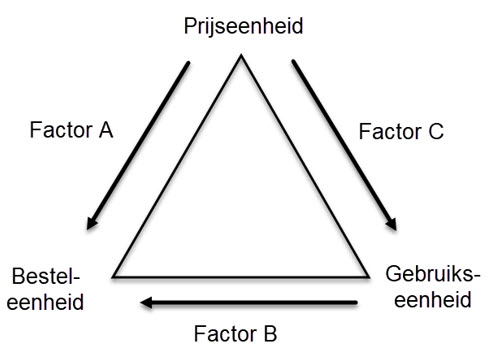
Figure 1 - Conversionfactor price unit, use unit and order unit
The above-mentioned units are of great importance for the installer and contractor or subcontractor. Alternative units might be enclosed to provide extra information to better understand the calculation. The mentioned alternative unit is always related to the trade item, and has a direct relation with the ‘parent unit’: Example related to insulation boards: user’s unit ‘6 pieces’ and alternative user’s unit ‘3 m2’. This means that there is 3m2 in a package (and not that one board is 3m2).
To calculate the various components of the triangle, the following formulas are employed:
Order unit and Price unit ratio
Factor A = (Order unit) / (Price unit)
Price unit = (Order unit) / (Factor A)
Order unit = Price unit × Factor A
Order unit and Use unit ratio
Factor B=(Order unit)/(Use unit)
Factor B is equal to the amount of use units within an ordering unit, as shown in the field <QuantityOfUseUnits> in the price catalogue message.
Use unit = (Order unit) / (Factor B)
Order unit = Use unit × Factor B
Price unit en Use unit ratio
Factor C = (Use unit) / (Price unit)
Price unit = (Use unit) / (Factor C)
Use unit = Price unit × Factor C
Other formulas
The price of 1 (minimum) ordering unit can be calculated in the following manner:
Price of the minimum Order quantity = (Minimum Order quantity × Factor A × Price) / (Number in Pricebase)
the price of 1 use unit is calculated in the following manner:
Price of the Use unit=(Factor C × Price)/(Number in Pricebase)
Factor C can be calculated using the following formula:
Factor C = (Factor A) / (Number use units)
In other words:
Factor C = (Factor A) / (Factor B)
With the examples found below, we aim to provide some insight into the possible combinations that might occur during the exchange of trade item data. Every example has its own difficulties for the determination of the correct values within the triangle. If the abovementioned formulas are, however, strictly adhered to, it should be possible to process the data in an unambiguous manner. The summary after every example aims to provide some insight in how software used by the receiving party might interpret the provided data.
Example 1 concerning a package of insulation boards
The difficulty with this example is found in the fact that the units of the calculation (square metres) differentiate from the ordering units (packages) and user’s units (boards). In the price catalogue all data is present to make the necessary conversions.
Example 2 concerning a box of screws
This example concerns a box of screws which have a different pricing unit as compared to what is within the package. Confusion might occur when calculating factor C, as, based upon the numbers in the triangle, it might seem illogical to note down ‘1’. Here, the ratio between the units is however of relevance. And as the units of price and usage are the same, the conversion factor of ‘1’ is applicable here..
Example 3 concerning a box with VD-wire
This example is added to provide insight into the selling units of goods that sell per metre.
Example 4 concerning a roll of sheet lead
Sometimes pricing units, ordering units and user’s units might differ, but the price catalogue message can anticipate this as well.
Example 5 concerning a single claw hammer
The easiest example, if all units are the same, all factors are ‘1’. However, the interpretation in the general summary might seem a little odd, this is how the software shall interpret it.
Example 6 concerning a box of sanding discs
Factor C cannot be incorporated in the price catalogue message, as this shall lead to differences in the rounding of the numbers, for which the example of sanding discs provides further insights.
4.1 Example 1: Insulation boards
The trade item concerns a package of isolation boards. At least one package should be ordered upon ordering. This particular package contains six insulation boards. The customer shall deduce the amount of boards needed from the total amount of m2 necessary to perform the job. The price of the trade item is calculated based upon the amount of m2 that the customer requests from the supplier.
Table 3 - Conversionfactor insulation boards
| Trade item informationl | Unit triangle | Element in XML-message | |
|---|---|---|---|
| Global Trade Item Number | 8712345678906 | <GTIN> | |
| Trade item number supplier | 1442112 | <SuppliersTradeItemId> | |
| Trade item description | Insulation board, package | <TradeItemDescription> | |
| Order terms | |||
| Minimum order quantity | 1 | <MinimumOrderQuantity> | |
| Unit quantity | PCE | Order unit | <OrderUoM> |
| Price to order unit factor | 3,6 | Factor A | <PriceToOrderUnitFactor> |
| Use information | |||
| Quantity of use units | 6 | Factor B | <QuantityOfUseUnits> |
| Use unit | PCE | Use unit | <UseUnitUoM> |
| Use unit Description | Slab | <UseUnitDescription> | |
| Package information | |||
| Package code | PK | <PackageTypeCode> | |
| Price information | |||
| Gross price | € 20 | <GrossPrice> | |
| Number of units in pricebase | 1 | <NumberOfUnitsInPriceBasis> | |
| Price unit | MTK | Price unit | <PriceBasisUoM> |
| Currency | EUR | <Currency> |
This example converted to the unit triangle:
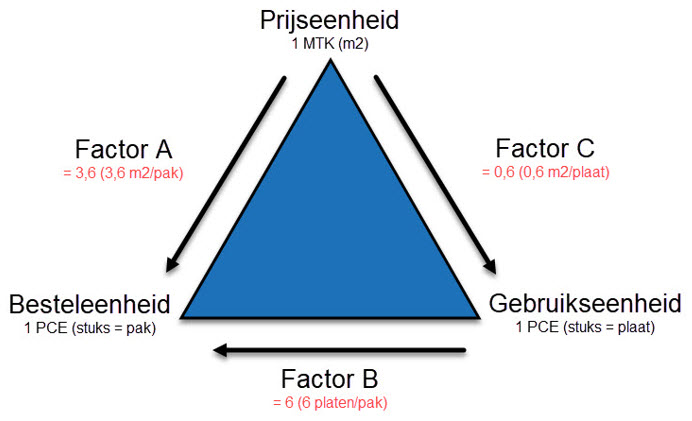
Figure 2 - Conversionfactor insultaion boards
To calculate the price of the minimum order, two boxes containing 200 screws, the following formula is used.
Price of the minimum Order quantity = (Number in Pricebase × Factor A × Price) / (Number in Pricebase)
Price of the minimum Order quantity = (2 × 200 × 2) / 100 = €8
The price of one user’s unit, which is one screw, is calculated as follows:
Price of the Use unit = (((Factor A) / (Number use units)) × Price) / (Number in Pricebase)
Price of the Use unit = ((200 / 200) × 2) / 100 = €0,02
Summarised:
One trade item is in this case one box (PCE) with 200 screws (PCE). A box with screws has a grossprice of €4,00. De minimum order quantity is 2 boxes and will €8,-. Therefore 1 screw (use unit) will cost €0,02.
4.2 Example 2: Box of screws
The trade items are black plasterboard screws, and these are packed in 1 box. The box contains 200 screws. If they want to order the plasterboard screws, they will have to order at least two boxes. The price is calculated based upon the amount of 100 pieces of screws. Extra attention for the use of the GTIN, in this particular example the GTIN belongs to the “box of screws” and not the single “screw” itself.
Table 4 - Plasterboards screws
| Trade item information | Unit triangle | Element in XML-message | |
|---|---|---|---|
| Global Trade Item Number | 8712345678913 | <GTIN> | |
| Trade item number supplier | 5678 | <SuppliersTradeItemId> | |
| Trade item description | Plasterboard screws black a 200 st 3,5 X 35mm | <TradeItemDescription> | |
| Order terms | |||
| Minimum order quantity | 2 | <MinimumOrderQuantity> | |
| Unit quantity | PCE | Order unit | <OrderUoM> |
| Price to order unit factor | 200 | Factor A | <PriceToOrderUnitFactor> |
| Use information | |||
| Quantity of use units | 200 | Factor B | <QuantityOfUseUnits> |
| Use unit | PCE | Use unit | <UseUnitUoM> |
| Use unit Description | screw | <UseUnitDescription> | |
| Package information | |||
| Package code | CT | <PackageTypeCode> | |
| Price information | |||
| Gross price | € 2 | <GrossPrice> | |
| Number of units in pricebase | 100 | <NumberOfUnitsInPriceBasis> | |
| Price unit | MTR | Price unit | <PriceBasisUoM> |
| Currency | EUR | <Currency> |
This example converted to the unit triangle:
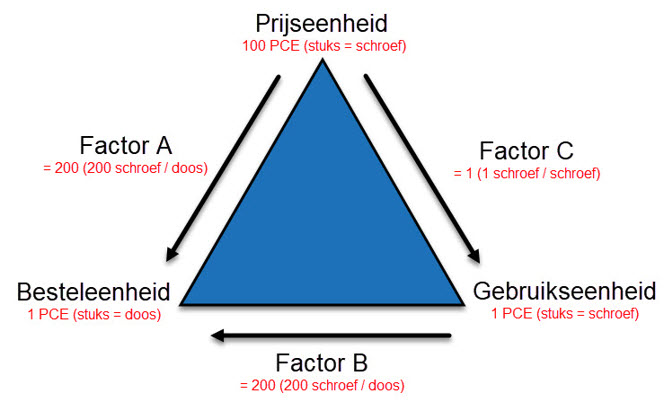
Figure 3 - Conversionfactor plasterboards screws
To calculate the price of the minimum order, two boxes containing 200 drywall screws, the following formula can be applied:
Price of the minimum Order quantity = (Number in Pricebase × Factor A × Price) / (Number in Pricebase)
Price of the minimum Order quantity = (2 × 200 × 2) / 100 = €8
The price of one user’s unit, which is one screw, is calculated as follows:
Price of the Use unit = (((Factor A) / (Number use units)) × Price) / (Number in Pricebase)
Price of the Use unit = ((200/200) × 2) / 100 = €0,02
Summarised:
One trade item is in this case one box (PCE) with 200 screws (PCE). A box with screws has a grossprice of €4,00. De minimum order quantity is 2 boxes and will €8,-. Therefore 1 screw (use unit) will cost €0,02.
4.3 Example 3: VD- wire
This trade item concerns a VD-wire. The trade item can ordered per carton box containing 100 metres of VD-wire. The customer shall determine the amount of wire needed from the total metres of wire necessary to perform the job. The conversion unit is determined to be one metre.
Table 5 - Conversionfactor VD-wire
| Trade item information | Unit triangle | Element in XML-message | |
|---|---|---|---|
| Global Trade Item Number | 8712345678920 | <GTIN> | |
| Trade item number supplier | 5814B | <SuppliersTradeItemId> | |
| Trade item description | VD-wire, 0.75mm2 | <TradeItemDescription> | |
| Order terms | |||
| Minimum order quantity | 1 | <MinimumOrderQuantity> | |
| Unit quantity | PCE | Order unit | <OrderUoM> |
| Price to order unit factor | 100 | Factor A | <PriceToOrderUnitFactor> |
| Use information | |||
| Quantity of use units | 100 | Factor B | <QuantityOfUseUnits> |
| Use unit | MTR | Use unit | <UseUnitUoM> |
| Package information | |||
| Package code | CT | <PackageTypeCode> | |
| Price information | |||
| Gross price | € 920 | <GrossPrice> | |
| Number of units in pricebase | 1000 | <NumberOfUnitsInPriceBasis> | |
| Price unit | MTR | Price unit | <PriceBasisUoM> |
| Currency | EUR | <Currency> |
This example converted to the unit triangle:
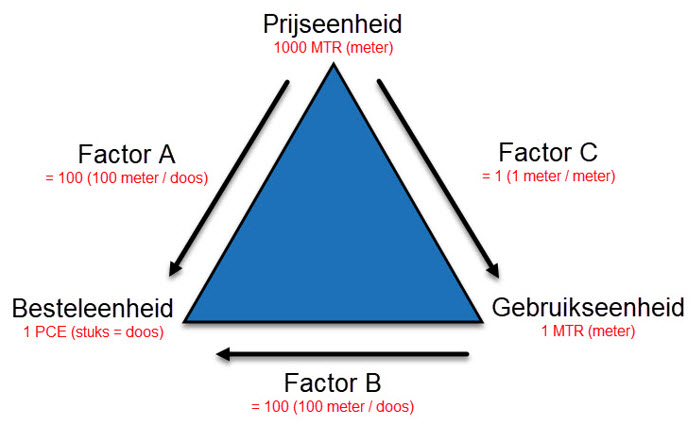
Figure 4 - Conversionfactor VD-wire
To determine the price for the minimum order (one box containing 100 metre of VD-wire), the following formula is used:
Price of the minimum Order quantity = (Number in Pricebase × Factor A × Price) / (Number in Pricebase)
Price of the minimum Order quantity = (1 × 100 × 920) / 1000 = €92
The price of one user’s unit (one metre VD-wire) is calculated as follows:
Price of the Use unit = (((Factor A) / (Number use units)) × Price) / (Number in Pricebase)
Price of the Use unit = ((920 / 1000) × 100) / 100 = €0,92
Summarised: One trade item is in this case 1 box (PCE) with 100 metres wire (MTR). A box with wire has a gross margin of €92,00. The minimum order is one package and costs thus €92,00. One metre (user’s unit) costs €0,92,-.
4.4 Example 4: A roll of (sheet) lead
This trade item concerns a roll of sheet lead, 18 pounds is 18kg/m2. The trade item can be ordered per piece (roll) of 3,3 metre. The use unit is thus in this example determined to be one metre. The other data can be found below:
Table 6 - Conversionfactor Sheet lead
| Trade item information | Unit triangle | Element in XML-message | |
|---|---|---|---|
| Global Trade Item Number | 8712345678937 | <GTIN> | |
| Trade item number supplier | 17 | <SuppliersTradeItemId> | |
| Trade item description | Sheet lead, 18 pds, 250mm wide | <TradeItemDescription> | |
| Order terms | |||
| Minimum order quantity | 1 | <MinimumOrderQuantity> | |
| Unit quantity | PCE | Order unit | <OrderUoM> |
| Price to order unit factor | 15 | Factor A | <PriceToOrderUnitFactor> |
| Use information | |||
| Quantity of use units | 3,3 | Factor B | <QuantityOfUseUnits> |
| Use unit | MTR | Use unit | <UseUnitUoM> |
| Package information | |||
| Package code | NE | <PackageTypeCode> | |
| Price information | |||
| Gross price | € 616 | <GrossPrice> | |
| Number of units in pricebase | 1000 | <NumberOfUnitsInPriceBasis> | |
| Price unit | KGM | Price unit | <PriceBasisUoM> |
| Currency | EUR | <Currency> |
This example converted to the unit triangle:
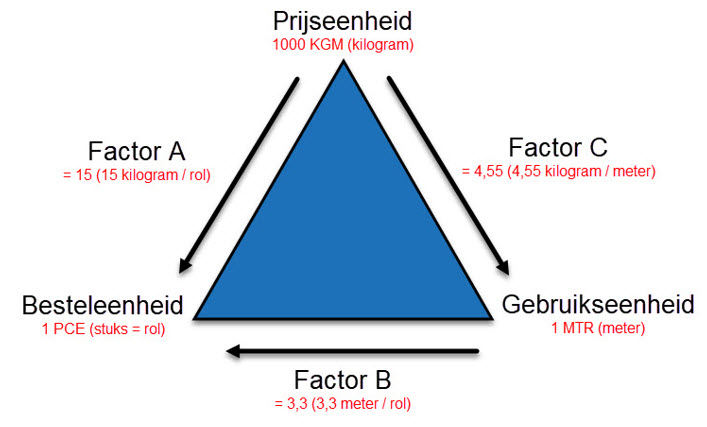
Figure 5 - Conversionfactor Sheet lead
To determine the price for the minimum order (one scroll rolled lead of 3,3 metre), the following formula is used:
Price of the minimum Order quantity = (Number in Pricebase × Factor A × Price) / (Number in Pricebase)
Price of the minimum Order quantity = (1 × 15 × 616) / 1000 = €9,24
The price of one user’s unit (one metre of rolled lead) is calculated as follows:
Price of the Use unit = (((Factor A) / (Number use units)) × Price) / (Number in Pricebase)
Price of the Use unit = ((15 / 3,3) × 616) / 1000 = €2,82
Summarised: One trade item is in this case 1 scroll (PCE) with 3,3 metres of rolled lead (MTR). A scroll with lead has a gross margin of €9,24. The minimum order is 1 scroll, and thus costs €9,25. One metre (user’s unit) costs €2,82.
4.5 Example 5: Claw hammer
The trade item concerns a claw hammer, 35 cm. the trade item can be ordered per piece.
Table 7 - Conversionfactor Claw hammer
| Trade item information | Unit triangle | Element in XML-message | |
|---|---|---|---|
| Global Trade Item Number | 8712345678944 | <GTIN> | |
| Trade item number supplier | 48LP | <SuppliersTradeItemId> | |
| Trade item description | Claw hammer, 35cm, gray | <TradeItemDescription> | |
| Order terms | |||
| Minimum order quantity | 1 | <MinimumOrderQuantity> | |
| Unit quantity | PCE | Order unit | <OrderUoM> |
| Price to order unit factor | 1 | Factor A | <PriceToOrderUnitFactor> |
| Use information | |||
| Quantity of use units | 1 | Factor B | <QuantityOfUseUnits> |
| Use unit | PCE | Use unit | <UseUnitUoM> |
| Package information | |||
| Package code | NE | <PackageTypeCode> | |
| Price information | |||
| Gross price | € 8 | <GrossPrice> | |
| Number of units in pricebase | 1 | <NumberOfUnitsInPriceBasis> | |
| Price unit | PCE | Price unit | <PriceBasisUoM> |
| Currency | EUR | <Currency> |
This example converted to the unit triangle:
Figure 6 - Conversionfactor Claw hammer
To determine the price for the minimum order (one claw hammer), the following formula is used:
Price of the minimum Order quantity=(Number in Pricebase ×Factor A ×Price)/(Number in Pricebase)
Price of the minimum Order quantity=(1 ×1 ×8)/1=€8,00
The price of one user’s unit (one claw hammer) is calculated as follows:
Price of the Use unit=(((Factor A)/(Number use units))×Price)/(Number in Pricebase)
Price of the Use unit=((1/1)×8)/1=€8,00
Summarised:
One trade item is in this case one hammer (PCE) with one hammer (PCE). A hammer with a hammer has a gross margin of €8. The minimum order is one hammer, and thus costs €8. One hammer (user’s unit) costs €8.
4.6 Example 6: Sanding discs
The trade item concerns sanding discs which are sold per three in a carton box. If one wishes to order the discs, these should be ordered per five boxes. The price is calculated per set of discs.
Table 8 - Conversionfactor sanding discs
| Trade item information | Unit triangle | Element in XML-message | |
|---|---|---|---|
| Global Trade Item Number | 8712345678789 | <GTIN> | |
| Trade item number supplier | 8976 | <SuppliersTradeItemId> | |
| Trade item description | Sanding disks, set of 3 pieces | <TradeItemDescription> | |
| Order terms | |||
| Minimum order quantity | 5 | <MinimumOrderQuantity> | |
| Unit quantity | PCE | Order unit | <OrderUoM> |
| Omrekenfactor prijs-Order unit | 1 | Factor A | <PriceToOrderUnitFactor> |
| Use information | |||
| Quantity of use units | 3 | Factor B | <QuantityOfUseUnits> |
| Use unit | PCE | Use unit | <UseUnitUoM> |
| Description | Disk | <UseUnitDescription> | |
| Package information | |||
| Package code | NE | <PackageTypeCode> | |
| Price information | |||
| Gross price | € 4,10 | <GrossPrice> | |
| Number of units in pricebase | 1 | <NumberOfUnitsInPriceBasis> | |
| Price unit | PCE | Price unit | <PriceBasisUoM> |
| Currency | EUR | <Currency> |
This example converted to the unit triangle:
Figure 7 - Conversionfactor sanding discs
To determine the price for the minimum order (five boxes with three discs), the following formula is used:
Price of the minimum Order quantity=(Number in Pricebase ×Factor A ×Price)/(Number in Pricebase)
Price of the minimum Order quantity=(5 ×1 ×4,10)/1=€20,50
The price of one user’s unit (one disc) is calculated as follows:
Price of the Use unit=(((Factor A)/(Number use units))×Price)/(Number in Pricebase)
Price of the Use unit=((1/3)×4,10)/1=€1,37
Summarised: One trade item is in this case one box (PCE) with three discs (PCE). A box with discs has a gross margin of €4,10. The minimum order is five boxes and thus costs €20,50. One disc (user’s unit) costs €1,37.
5 Trade item hierarchy
The trade item hierarchy is the relation between the product and higher trade item levels. For every package, it can be made known what is within it.
In order to employ the trade item hierarchy, it is necessary for every package to have its own trade item code. With every package it has been indicated how many pieces of the lower levels are enclosed within the trade item hierarchy. The lowest level in the trade item hierarchy is recognisable by the missing of a reference to a lower/enclosed packaging form.
Points of attention regarding the trade item hierarchy:
- For every product the entire trade item hierarchy is communicated, so even the ‘in-between’ levels that cannot be ordered;
- The trade item hierarchy can be used for combination packaging as well, which would mean that various types of trade items are packaged together;
- Translation of the messages from an internal file means that within the file a relation is defined between various trade items and packaging forms;
- For every package, the amount of user’s units is always indicated.
Changes in the Trade item hierarchy
If an trade item is modified, this might have consequences for other trade items within the trade item hierarchy. This information is expected to be exchanged with the price catalogue message:
- A new trade item will always result in a new trade item hierarchy, where all higher-situated trade items shall be given a new GTIN as well;
- An existing trade item shall result in an exchange of the complete trade item hierarchy as well, where all higher-situated trade items shall be given a new GTIN.
With higher-situated packages, the trade item hierarchy can be used to indicate how many trade items of lower levels are contained within. At the lowest level (level 0), only the product characteristics are indicated, and no amounts. As of level 1 onwards, the amount of user’s units can be calculated for every package, see figure 10. This is known as ‘relative reference’; the package itself refers to the lower-situated package. Next to this, it is possible for every package to ‘directly’ indicate the amount of user’s units; which is known as ‘absolute reference’.
Example of an trade item hierarchy
At every packaging level, the content is made known through a reference to the enclosed trade item and through mentioned the user’s unit and the amount of user’s units within the package.
The assumption with this example is that the blister packages are not sold individually at orders between the manufacturer and the wholesale business. Level 2 can thus not be ordered for the wholesale business in this example. Level 2 can, however, be ordered in the relation between wholesale business and installer.
| Level 3: Trade item Box led lights 3 blisters of GTIN 08738023400014 enclosed Orderable GTIN 08721023454111 |  |
| Level 2: Trade item Blister led lights 6 pieces of GTIN 08762023400021 enclosed Orderable for installer Not orderable for wholesalers GTIN 08738023400014 |  |
| Level 1: Trade item Packaged led light 1 piece of GTIN 08712023400008 enclosed Orderable GTIN 08762023400021 |  |
| Niveau 0: Product Unpackaged led lamp (60W/230V, E27) Non-orderable GTIN 08712023400008 |  |
Figure 8 - Example for Trade item hierarchy
This means the following for price catalogue data:
Table 9 - Trade item data
| Level 1 Trade item | Level 2 Trade item | Level 3 Trade item | |
|---|---|---|---|
| GTIN | 08762023400021 | 08738023400014 | 08721023454111 |
| Suppliers description | Led light, E27 | Led light, E27 | Led light, E27 |
| Orderable | Yes | Yes | Yes |
| Order unit | PCE (piece) | PCE (piece) | PCE (piece) |
| Price to order factor | 1 | 1 | 1 |
| Minimum order quantity | 3 | 1 | 1 |
| Step size | 3 | 1 | 1 |
| Unit quantity | PCE (piece) | PCE (piece) | PCE (piece) |
| Delivery time | 1 | 1 | 1 |
| Unit delivery time | 804 (dagen) | 804 (dagen) | 804 (dagen) |
| Number of use units | 1 | 6 | 18 |
| Use unit | PCE (piece) | PCE (piece) | PCE (piece) |
| Number of price unit per price | 1 | 1 | 1 |
| Price unit | PCE (piece) | PCE (piece) | PCE (piece) |
| Package code | CT | BME | |
| Grossweight | 120 | 750 | 2,4 |
| Weight unit | GRM | GRM | |
| Allowancegroup | 75-456 | 75-498 | 75-487 |
| Number enclosed trade items | 1 | 6 | 3 |
| GTIN enclosed trade item | 08712023400008 (product) | 08762023400021 | 08738023400014 |
At every packaging level the content is made known through a reference to the enclosed trade item and by mentioning the user’s unit and the amount of user’s unit within the package.
6 Discounts and surcharges
Discounts and surcharges might concern an individual trade item within an order or the order as a whole. The reductions that may rest upon individual trade items (dependent upon way of delivery) are supported with the price catalogue message. The following types of discounts and surcharges can be indicated within the price catalogue message:
- Reductions concerning the gross margin, such as trade reduction/standard reductions and scale discounts;
- Discounts concerning the gross margin processing fee;
- Additional discounts dependent upon the means of delivery, such as pick-up discount, warehouse delivery discount/direct delivery.
The following agreements have been made concerning the calculating of a price from the gross margin and discounts/surcharges:
- With every trade item it can be indicated to which discount group it might belong. All trade items within this group have the same reduction percentage. The various discounts/surcharges can be specified as well. This is not necessary if the trade item belongs to a specific discount group. If the various discounts/surcharges are specified while a discount group is applicable as well, than the discount relating to the discount group can be ignored (the discount group is thus ‘overruled’); van de kortingsgroep genegeerd kan worden (de kortingsgroep wordt dus 'overruled');
- Trade discount/standard discount is indicated as an amount relative to the gross margin, or as a percentage of the gross margin;
- A trade surcharge/standard surcharge may not be employed;
- The nett price is a derivative from the gross margin, gross margin processing fee, trade discount/standard discount and discounts related to the processing fee. Do mind, situations in which only a nett price is communicated might occur;
- When using several reductions or surcharges, a serial number is obligatory;
- Filling out both the gross margin and the nett price ‘fields’ is not expected, if this is the case, then the nett price’s field is leading and the additional discounts/surcharges are merely for information and checking; *The gross margin in the pricing list is based upon the pricing unit (e.g. one piece), excluding order-dependent discounts and/or surcharges;
- With scale discounts, the supplier provides per lower limit bulk the total discount percentage of the trade discount and scale discount(s) relative to the gross margin and/or the total discount of the trade discount and scale discount relative to the gross margin.
- Scale discounts are always indicated with the code QD;
- If both the discount percentage and the discount amount are present, the percentage is leading and the discount amount merely serves as additional information. This is the case for both scale discount as for delivery-dependent discounts;
- Whether a discount concerns a direct, pick-up or warehouse discount is dependent upon the manner of delivery to the customer. These discounts can only be indicated as a particular amount and/or percentage. For the calculation of the eventual price, it shall first be determined what the price is after the application of the before-mentioned discounts (+ processing fee with, if relevant, any related discounts). Two types can be distinguished for the calculation of the final price:
- Discount type which includes scale discount. In this situation, delivery-dependent discounts are calculated over the scale discounts, thus: first the scale discount is calculated and based upon this number the delivery-dependent discounts;
- Discount type which does not include scale discount. It is not allowed to calculate any discount (delivery-dependent) over discount (scale) in the price catalogue message;
- The price is determined based on the percentage/amount indicated for the relevant lower limit bulk discount.
- The eventual price of a price might be increased with a processing fee, the gross margin processing fee in combination with any relevant discount;
- The discount over the processing fee might be indicated as a percentage of the gross margin processing fee, or as a discount amount relative to the gross margin processing fee. With this discount over the processing fee, a lower limit might have been set in the lower limit bulk. The discount is then only relevant if more pricing units are ordered as compared to what is indicated in the lower limit.
6.1 Price determination
In order to arrive from a gross margin to the nett price, the discounts and surcharges are calculated independently.
Figure 9 - Splitted calculation for allowance and charge
Several calculation rules have been determined.
- When setting both a gross margin and a nett price, the nett price is leading:
- Any accompanying gross margin, discounts and surcharges are merely informative and used to check the determination of the price. However, even if only to provide information, these data are expected to be complete.
- If a discount or surcharge is included, the mentioning of a gross margin is obligatory;
- The base amount to calculate the nett price is the gross margin;
- When mentioning various discounts or surcharges within the trade item line, using a serial number is obligatory. For correct employment of such numbers, see table 10;
- When using a serial number, these are to be sequential;
- The discounts and the surcharges are calculated individually and always relative to the gross margin;
- The discounts and surcharges are settled with the gross margin to determine the nett price;
- It is not recommended to mention both nett price as gross margin.
Table 10 - Example for using reference numbers
| Allowance | Reference number | Charge | Reference number |
|---|---|---|---|
| QD | 1 | FC | 1 |
| ADO | 2 | AEM | 2 |
| TD | 3 | ADR | 3 |
| ADR | 4 |
Example allowance over allowance:
Table 11 - Example for using “allowance over allowance”
| Gross price 100 euro | No allowance | Trade allowance | Bulk lower limit 101 | Bulk lower limit 1001 | Bulk lower limit 10.000 | |
|---|---|---|---|---|---|---|
| 1 | Lower limits | |||||
| Allowance percentage | 20% | 30% | 40% | 60% | ||
| Allowance amount | 20 euro | 30 euro | 40 euro | 60 euro | ||
| Net amount | 80 euro | 70 euro | 60 euro | 40 euro | ||
| 2a | Direct delivery | |||||
| Allowance percentage | +5% | +5% | +5% | +5% | +5% | |
| Allowance amount | 5 euro | 4 euro | 3,50 euro | 3 euro | 2 euro | |
| Net amount | 95 euro | 76 euro | 66,50 euro | 57 euro | 38 euro | |
| 2b | Pick up | |||||
| Allowance percentage | +10% | +10% | +10% | +10% | +10% | |
| Allowance amount | 10 euro | 8 euro | 7 euro | 6 euro | 4 euro | |
| Net amount | 90 euro | 72 euro | 63 euro | 54 euro | 36 euro |
An order has been placed for the delivery of 50 packages pre-packaged boards of insulation material. The gross margin for one package amounts to 20 euros. The discount type for scale reduction has been enclosed. As such, there is a discount (delivery-dependent) over discount (scale). Based upon the table shown above, this would amount per delivery to the following net price:
Table 12 - Net price for a delivery scenario
| Grossprice 20 euro per package | Direct delivery | Pick up |
|---|---|---|
| Total grossprice | 1.000 euro | 1.000 euro |
| Lower limit 30% 300 euro | 300 euro | |
| Amount including lower limit | 700 euro | 700 euro |
| Allowance delivery | 5% | 10% |
| Allowance amount delivery | 35 euro | 70 euro |
| Total net price | 665 euro | 630 euro |